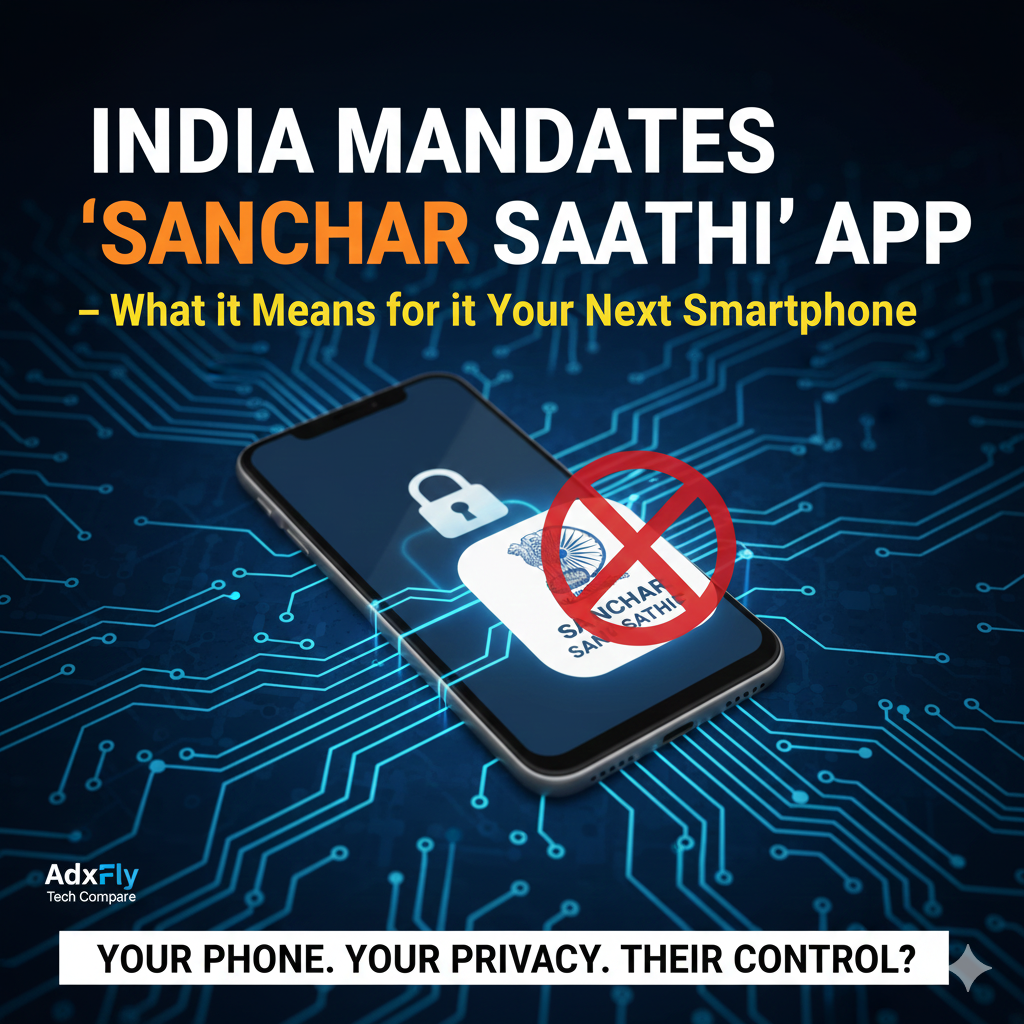
Introduction: The New Government Mandate
In a significant move aimed at enhancing digital security and tackling device theft, the Government of India, through the Department of Telecommunications (DoT), has mandated that all new smartphones sold in the country must come with the Sanchar Saathi mobile application pre-installed.
This order, reportedly issued privately to major smartphone manufacturers like Apple, Samsung, Xiaomi, and OnePlus, gives companies a deadline to ensure this state-owned cybersecurity app is on all new devices, with the crucial provision that users cannot uninstall or disable it. AdxFly Tech Compare analyzes this mandate, the purpose of the app, and its implications for smartphone users and manufacturers in India.
1. The Core Purpose: Tracking and Security
The Sanchar Saathi app is not just another utility; it is a citizen-centric tool designed to combat identity theft, device fraud, and tackle the massive black market for stolen mobile devices.
A. Tracking Lost or Stolen Phones (H3)
The app’s primary function is to integrate with a central registry that allows users to quickly block and track lost or stolen smartphones across all telecom networks. Government data indicates the app has already been successful, helping to block millions of stolen devices and trace hundreds of thousands.
B. Combating Fraudulent Connections (H3)
A secondary, but equally vital, function is allowing users to check how many mobile connections are registered under their name and easily identify and report fraudulent connections (SIM cards obtained using forged KYC documents).
Success Rate: Since its launch, the app has helped block millions of devices and terminate millions of fraudulent mobile connections, showcasing its efficacy in the world’s largest telephone market.
2. The Manufacturer’s Compliance Challenge
The DoT order presents a unique challenge to global smartphone giants, particularly regarding the non-removable status of the app.
A. Pre-installation vs. Software Updates (H3)
- New Devices: Companies must bake the app into the final firmware of all devices manufactured and shipped post-mandate (typically within a 90-day window).
- Existing Inventory: For phones already in the supply chain or retail, manufacturers are required to push the Sanchar Saathi app to these devices via mandatory software updates.
B. The Non-Removable Constraint (H3)
The mandate that the app cannot be deleted by the user is the key point of contention and technical complexity. This requires deep integration into the operating system (both Android and iOS, if applied broadly), raising questions about user control over pre-installed applications.
3. Implications for the Indian Smartphone User
What does this mean for consumers buying a new phone from 2026 onwards?
A. Enhanced Security (H3)
The mandate is a massive win for user security. It establishes a unified, government-backed layer of protection against device theft and ensures a clear process for reporting loss, ultimately reducing the market incentive for phone theft.
B. Storage and Privacy (H3)
The app consumes local storage and may use background resources, slightly impacting overall phone performance (though the app is reported to be lightweight). While the government asserts the app’s purpose is purely security-related, the non-removable nature will inevitably lead to public discussions around user privacy and system resource allocation.
C. The Pre-loaded App Landscape (H3)
The inclusion of a non-removable app sets a precedent in the Indian market, potentially normalizing the inclusion of essential government-mandated security software on consumer electronics.
Conclusion: Security Trumps Customization
This mandate is a definitive step by the Indian government to clean up the digital environment. While manufacturers face a tight deadline for compliance, and users must accept a non-removable application, the trade-off is significant: a safer digital ecosystem with robust tools to fight device theft and fraud. For the consumer, this pre-installed security layer is an essential, albeit mandatory, enhancement to the smartphone experience.