Introduction: The Charging Speed War is Over, Efficiency is King
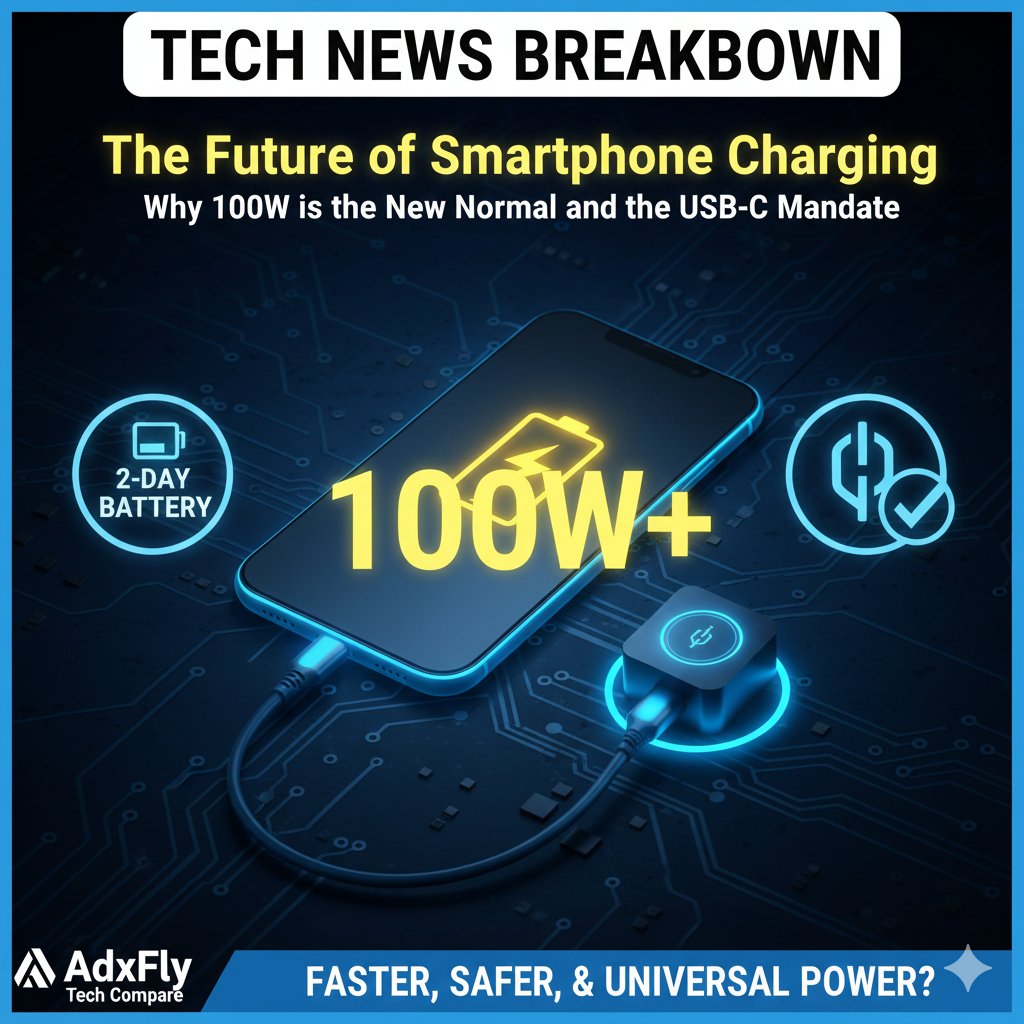
For years, smartphone brands competed to advertise the fastest charging wattage—120W, 150W, even 200W. However, as we look towards 2026, the industry is settling on a new, highly efficient standard: 100W charging combined with massive batteries. This shift is driven by a focus on battery longevity, new battery materials, and critical regulatory changes like the global USB-C mandate.
AdxFly Tech Compare dives into the three major trends defining the future of smartphone power: the move towards two-day battery life, the new charging speed sweet spot, and the mandatory adoption of USB-C in markets like India.
1. The Two-Day Battery Reality: Silicon-Carbon Power
The biggest innovation isn’t in the charger, but in the battery itself.
A. The Role of Silicon-Carbon Anodes (H3)
Manufacturers, particularly in Asia, are rapidly integrating Silicon-Carbon (Si-C) anodes into their smartphone batteries. Silicon can store significantly more lithium ions than traditional graphite anodes, allowing brands to pack higher capacity (6,000mAh, 7,000mAh, and even testing 10,000mAh) into the same physical size.
- Impact: This new chemistry means that by 2026, two-day battery life will become the norm for many flagship and mid-range devices, effectively eliminating “battery anxiety.”
B. The Charging Speed Sweet Spot (H3)
With these larger batteries, the industry has found that 90W to 100W wired charging is the ideal standard.
- Why Not 150W+? Ultra-high wattage (150W+) generates excessive heat, which rapidly degrades the Silicon-Carbon batteries. The 100W standard is fast enough to charge a massive 7,000mAh battery in around an hour without causing unnecessary degradation.
2. The Standardization Mandate: USB-C Dominates
Regulatory bodies globally are forcing standardization, which profoundly impacts design, waste, and convenience.
A. Global USB-C Mandate (H3)
Aligning with the European Union, the Indian government is set to enforce a regulation mandating USB-C connectors on all smartphones and laptops sold in the country.
- Deadline: The mandate for smartphones is anticipated by mid-2025, with laptops following by the end of 2026.
B. Impact on Consumers (H3)
The mandate is a huge win for consumers:
- Reduced E-Waste: Users only need one charger (USB-C) for their phone, tablet, and laptop, dramatically reducing electronic waste.
- Harmonized Fast Charging: The regulation aims to harmonize fast charging protocols, ensuring that charging speeds are consistent even when using a third-party USB-C charger.
3. The Future of Wireless Charging
While wired charging becomes faster and standardized, wireless technology continues its slow evolution.
A. Qi2 Standard Adoption (H3)
The new Qi2 wireless charging standard is set to become mainstream, offering a Magnetic Power Profile similar to Apple’s MagSafe. This magnetic alignment improves efficiency and charging speed (up to 15W), making wireless charging more reliable and less prone to overheating.
- Who Benefits: All Android and iOS users, as it creates a universal magnetic wireless ecosystem.
B. Beyond Contact Charging (H3)
While still an experimental technology, companies continue to invest in truly wireless, over-the-air charging, which could power devices from several feet away. While it won’t be ready for mass market by 2026, foundational chip advancements are being made now to support this future.
Conclusion: A More Convenient Power Future
The charging landscape is changing for the better. Consumers can look forward to a world where two-day battery life is common, all devices charge via a single, fast USB-C cable, and wireless charging is magnetically optimized and reliable. This shift represents a huge victory for both convenience and environmental sustainability in consumer electronics.