Introduction: The x86 Counter-Attack on Apple Silicon
For years, Apple’s M-series chips (M1, M2, M3, M4) have set the standard for power efficiency in laptops. Now, Intel is fighting back with a completely redesigned architecture: the Lunar Lake processor (part of the Core Ultra Series 2).
The battle is no longer about raw CPU speed; it’s about performance-per-watt and who can run AI tasks most efficiently. AdxFly Tech Compare analyzes the latest benchmarks and architectural changes to determine if Intel has finally built an x86 chip that can challenge Apple’s M4 for battery life and AI dominance.
1. The Core Architecture: Efficiency vs. Integration
Both chips were built using cutting-edge 3nm technology, but their fundamental design philosophies differ.
A. Intel Lunar Lake: The Efficiency Overhaul (H3)
Intel’s Lunar Lake is a complete ground-up redesign focused on power savings. Key features include:
- Memory on Package (MoP): Integrating LPDDR5X DRAM directly onto the chip package. This innovative design boosts data transfer speeds by over 30% while reducing power consumption by up to 40% in memory access compared to previous generations.
- New Cores: Features the new Lion Cove P-cores and highly efficient Skymont E-cores, with Intel aiming to achieve Mac-like efficiency levels, especially during light, everyday use.
B. Apple M4: Unified Memory Dominance (H3)
The Apple M4 maintains its Unified Memory Architecture (UMA), where the CPU, GPU, and Neural Engine all share a single pool of memory. This architecture provides massive bandwidth (up to 120 GB/s) and near-instant data transfer, giving it a crucial advantage in professional workloads.
2. The AI Battle: NPU Power and TOPS
AI capabilities, measured in TOPS (Trillion Operations Per Second), are the new metric for laptop supremacy.
| AI Component | Intel Lunar Lake (Gen 4 NPU) | Apple M4 (Neural Engine) |
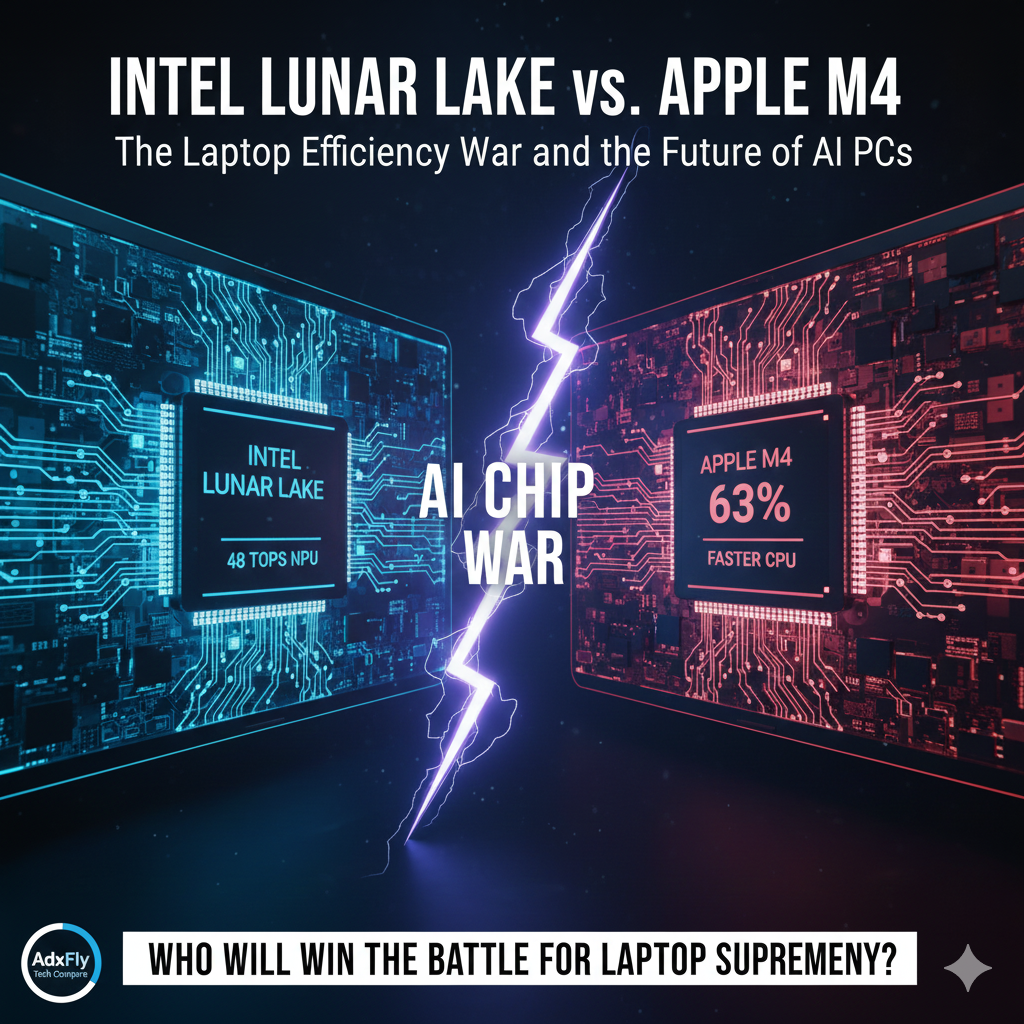
| NPU TOPS (Peak) | Up to 48 TOPS | Up to 38 TOPS |
| Total Platform TOPS | Up to 120 TOPS (CPU + GPU + NPU) | Not officially specified in the same way |
| AI Performance in Benchmarks | Stronger NPU performance (by TOPS metric) | Significantly faster in real-world AI benchmarks (up to 80% faster in some tests) |
- The Reality Check: While the Intel Lunar Lake NPU technically boasts a higher TOPS number (48 TOPS vs. M4’s 38 TOPS), benchmark testing shows the Apple M4’s Neural Engine is often significantly faster (60-80% lead) in real-world, on-device AI tasks (like processing large language models and image recognition). This is a testament to Apple’s highly optimized software stack.
3. Benchmark Showdown: Raw Performance
Benchmarking shows Apple still holds a decisive lead in raw CPU power and graphics.
A. CPU Performance (H3)
The Apple M4 CPU consistently outperforms the Intel Lunar Lake Core Ultra 7 in both single-core (up to 48% faster) and multi-core (up to 63% faster) tests (Cinebench and Geekbench). This dominance means the M4 finishes heavy tasks much faster, returning to an idle state sooner—the essence of efficiency.
B. GPU and Gaming (H3)
The Apple M4’s 10-core GPU also shows a strong lead, performing up to 40% faster than the Intel Arc 140V GPU in graphics tests. While Intel may win in certain Windows-optimized gaming titles (due to driver support and XeSS), the M4 offers superior raw graphical muscle.
4. Final Verdict: The Ecosystem Divide
The Lunar Lake is Intel’s most competitive chip in years, closing the efficiency gap significantly. However, benchmarks confirm that Apple Silicon still holds a commanding lead in performance-per-watt and single-core speed.
👉 Choose Intel Lunar Lake If:
- You require Windows compatibility, broad hardware variety (touchscreens, 2-in-1s), and dedicated PC gaming support.
- You need external Thunderbolt port flexibility and a wide range of OEM choices (Dell, HP, Lenovo).
👉 Choose the Apple M4 If:
- You demand the highest single-core speed and the best battery life for professional workloads.
- You are already invested in the seamless integration and high performance of the macOS/Apple ecosystem.
AdxFly’s Final Word: While Intel has fought admirably to improve power efficiency, the Apple M4 maintains the performance and efficiency crown, thanks to its unified memory architecture and highly optimized AI engine.