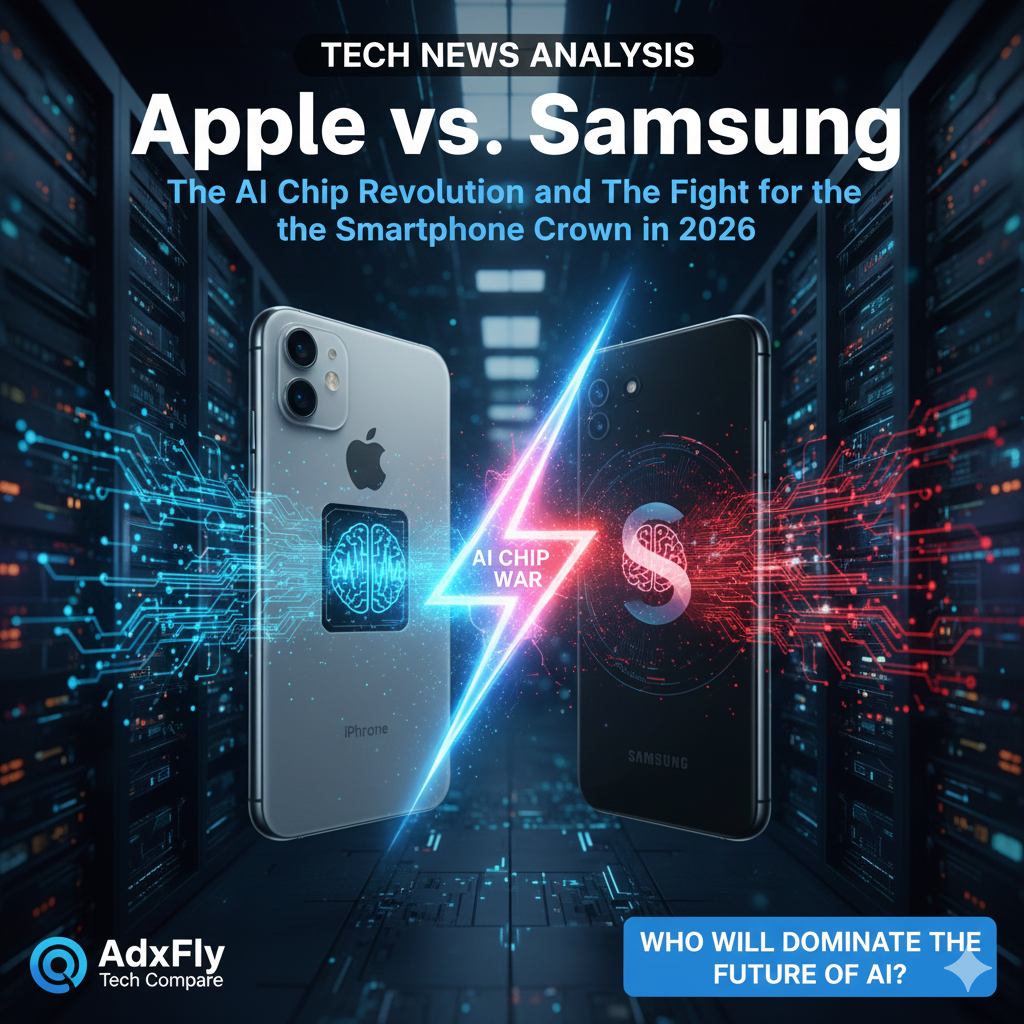
Introduction: The Tectonic Shift in the Smartphone Market
The global smartphone landscape is on the cusp of its biggest leadership change in over a decade. Recent reports suggest that Apple is poised to overtake Samsung as the world’s largest smartphone shipper in 2025-2026, driven by strong iPhone 17 demand and a massive upgrade cycle.
However, the real war is not just about sales volume; it’s about AI hardware. AdxFly Tech Compare analyzes the key factors driving this market shift and examines how the next generation of AI-powered chips from Qualcomm, MediaTek, and Google will redefine the 2026 flagship experience.
1. The Market Leadership Battle: Apple’s Edge
For nearly 14 years, Samsung has held the volume crown, but several factors are pushing Apple to the top spot:
A. The COVID-Era Replacement Cycle (H3)
Millions of users who purchased phones during the 2020-2022 period are now entering their upgrade phase. Apple, with its loyal user base and strong ecosystem, is successfully capturing a large portion of these high-value upgraders.
B. iPhone 17 Demand and Strategy (H3)
Reports indicate that the iPhone 17 series has seen significantly higher early sales than its predecessor in key markets like the US and China. Furthermore, Apple’s long-term strategy, including the rumored launch of a more budget-friendly iPhone 17e in 2026 and their long-awaited foldable iPhone, is designed to sustain their lead through the end of the decade.
C. Samsung’s Pressure (H3)
While Samsung maintains its lead in overall Android diversity, it faces intense pressure from aggressive Chinese brands (like Xiaomi and Oppo) in the mid-range and budget segments, which limits its ability to grow volume quickly enough to match Apple’s premium growth.
2. The Next Frontier: Flagship Chipset War (2026)
The real technical innovation in 2026 will be driven by the new generation of processors: Snapdragon 8 Elite Gen 5 and its rivals. The focus is shifting entirely from raw speed to on-device Artificial Intelligence (AI).
A. Snapdragon 8 Elite Gen 5: The Performance King (H3)
Qualcomm’s latest chip, the Snapdragon 8 Elite Gen 5, built on the cutting-edge 3nm process, boasts significant performance improvements (up to 36% overall) due to its custom-built Oryon CPU cores.
- AI Focus: The new Hexagon NPU is designed for agentic AI assistants that can learn user habits and process complex tasks offline—a major privacy and speed win.
B. MediaTek’s Challenge and Efficiency (H3)
MediaTek continues to close the gap with its Dimensity 9500 (or equivalent). While Qualcomm often leads in peak single-core performance, MediaTek aims for better sustained efficiency and strong GPU performance. The competition between their respective NPUs is driving advanced features like real-time AI video enhancements and superior power management.
3. The AI Hardware Revolution: Beyond the Smartphone
The advancements in mobile chips are fueling a broader AI hardware push:
- Smart Glasses and AR: Chips are being designed to integrate AI into smart glasses (like those rumored from Apple), allowing real-time object identification, translation, and contextual directions based on what the user is seeing.
- On-Device Generative AI: By 2026, analysts predict that over 30% of global smartphones shipped will be “GenAI smartphones,” capable of running large language models (like complex image generation or text summaries) locally without connecting to the cloud.
Conclusion: Value is Now Defined by AI
The smartphone market’s shift is less about who makes the best phone and more about who commands the ecosystem (Apple) and who builds the best foundational hardware (the chipmakers).
For consumers in 2026, the choice will not simply be between iPhone and Android, but between the AI experience offered by Apple’s seamless integration versus the raw, customizable AI power delivered by the latest Snapdragon-powered Android flagships.