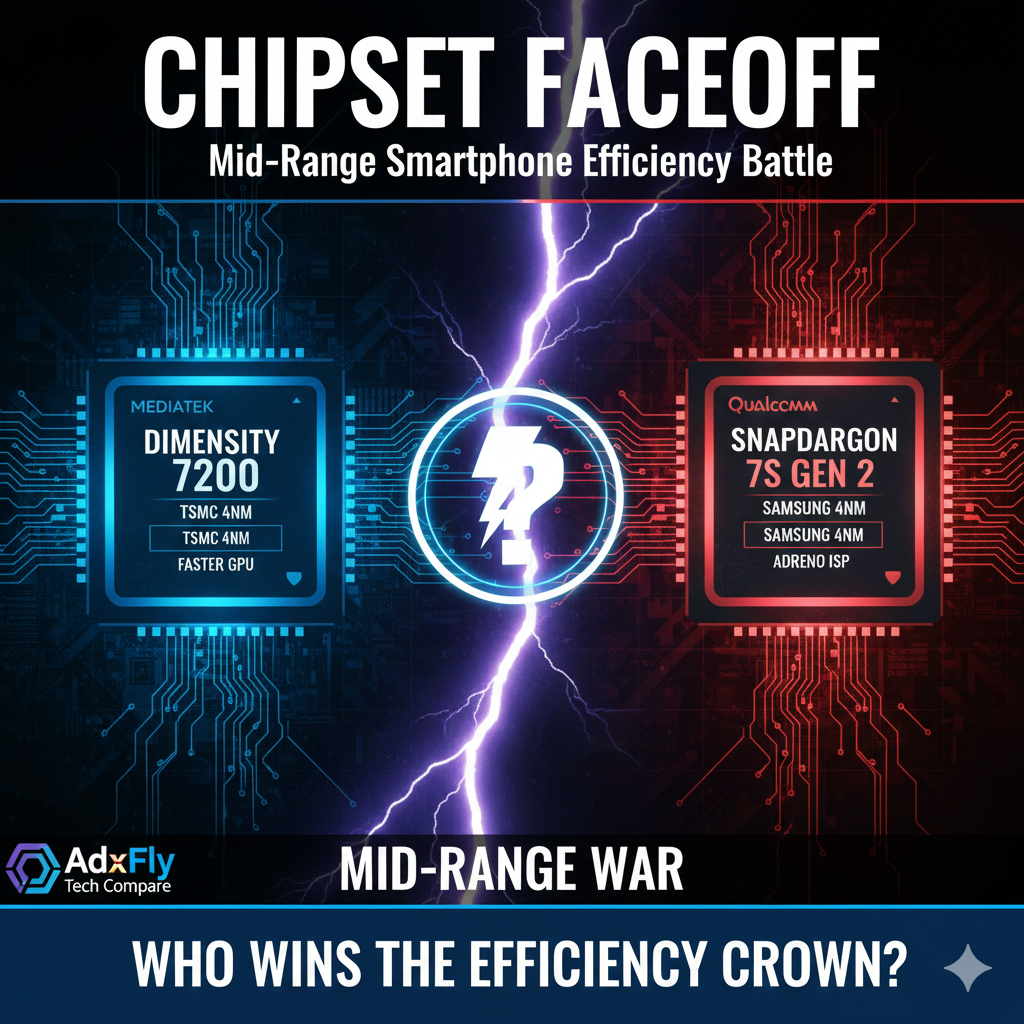
Introduction: The New Mid-Range Powerhouses
The mid-range smartphone market is defined by its processor. Today, the choice often pits the efficiency-focused MediaTek Dimensity 7200 (built on TSMC’s 4nm) against the balanced Qualcomm Snapdragon 7s Gen 2 (built on Samsung’s 4nm). Both chips power popular phones like the Nothing Phone (2a) and various Xiaomi/Poco models, promising 5G speed and smooth performance.
But which chipset provides better thermal management, superior gaming performance, and longer battery life? AdxFly Tech Compare dives deep into the architecture, benchmarks, and real-world efficiency of these two core competitors.
Quick Specifications Overview
| Feature (विशेषता) | MediaTek Dimensity 7200 | Qualcomm Snapdragon 7s Gen 2 |
| Manufacturing Process | TSMC 4nm (More Efficient) | Samsung 4nm |
| High-Performance Cores | 2x Cortex-A715 (Newer ARM) | 4x Cortex-A78 (Older ARM) |
| GPU | Mali-G610 MC4 | Adreno 710 |
| Max Download Speed | Up to 4.7 Gbps | Up to 2.9 Gbps |
| Antutu Score (Approx.) | ~708,000 to 750,000 | ~584,000 to 620,000 |
| Thermal Focus | High Thermal Stability | Balanced Performance |
1. Performance and Architecture
While both are built on a 4nm process, the foundry and core choices create a performance gap.
A. CPU Core Design (H3)
The Dimensity 7200 utilizes newer, more efficient ARM Cortex-A715 cores for its performance cluster. Although it uses fewer high-performance cores (2x A715 vs. 4x A78 on the Snapdragon), its modern design gives it a slight edge in single-core benchmarks and power efficiency.
The Snapdragon 7s Gen 2 uses older Cortex-A78 cores. However, having four A78 cores results in better multi-core scores in certain stress tests, making it excellent for heavy multitasking, though at the expense of slight power efficiency.
B. Raw Benchmarks (H3)
In overall performance tests like AnTuTu 10, the Dimensity 7200 typically scores significantly higher (upwards of 120,000 points more than the Snapdragon 7s Gen 2). This demonstrates the Dimensity 7200’s superior overall capability, particularly in the GPU department.
2. Gaming, Graphics, and Thermal Efficiency
For gamers, the GPU and thermal stability are the key deciding factors.
A. GPU Performance (H3)
The Dimensity 7200‘s Mali-G610 MC4 GPU consistently outperforms the Adreno 710 in the Snapdragon 7s Gen 2. Benchmarks and real-world tests show the Dimensity 7200 delivering smoother, more stable frame rates in demanding titles like Genshin Impact and CoD Mobile.
B. Thermal Management (H3)
Thanks to its manufacturing on TSMC’s 4nm process (generally considered more efficient than Samsung’s 4nm used for the Snapdragon 7s Gen 2), the Dimensity 7200 demonstrates better thermal stability and less performance throttling during extended gaming sessions. This makes phones powered by the 7200 run cooler.
3. Connectivity and Camera Support
A. 5G Modem (H3)
The Dimensity 7200‘s integrated 5G modem supports significantly higher peak download speeds (up to 4.7 Gbps) compared to the Snapdragon 7s Gen 2’s modem (up to 2.9 Gbps). While real-world speeds rarely hit these peaks, the Dimensity offers superior bandwidth capability.
B. Camera (H3)
Both chips support high-resolution cameras (up to 200MP). However, Snapdragon traditionally boasts a slight edge in ISP (Image Signal Processor) optimization and developer support, often leading to better out-of-the-box results in third-party camera apps.
Final Verdict: Performance vs. Ecosystem
👉 Choose the MediaTek Dimensity 7200 If:
- You prioritize gaming stability, raw GPU power, and smoother frame rates.
- You want the best power efficiency and cooler running experience.
- You seek superior overall performance demonstrated by benchmark scores.
👉 Choose the Qualcomm Snapdragon 7s Gen 2 If:
- You prioritize ecosystem support and the historical stability of Snapdragon’s Adreno GPU and ISP.
- You are looking for a phone with better multi-core performance for heavy multitasking.
AdxFly’s Final Word: The MediaTek Dimensity 7200 is the clear winner for performance and gaming efficiency in the mid-range segment today, thanks to its superior GPU and modern TSMC architecture.